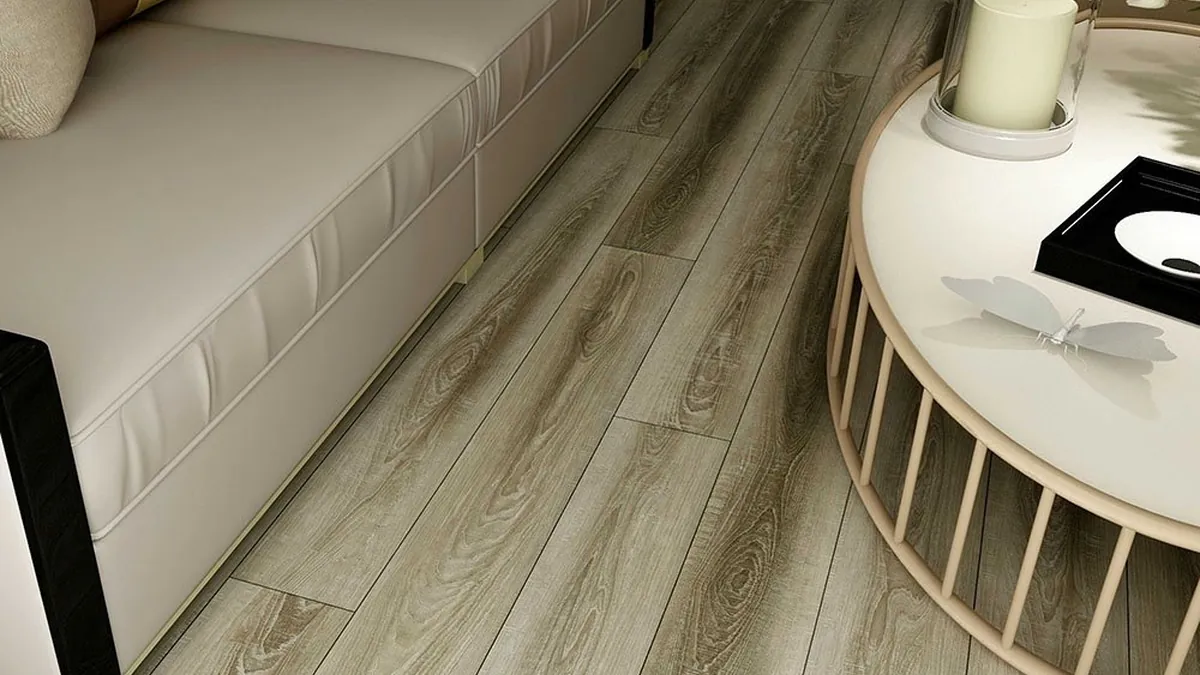
Two SPC floors can look identical in a photograph, carry the same plank size and the same printed design, and still be different products. The number that separates them is the wear layer: the transparent film above the print, and the only part of the floor that touches a shoe.
For an importer this matters commercially. The wear layer is the main driver of both unit cost and service life, and it is the number a warranty is written against. Get it wrong and you either overpay on a product nobody needed, or you sell a floor into traffic it cannot survive.
What the number actually measures
Wear layers are quoted in millimetres, and one millimetre is 1,000 microns. A 0.3 mm wear layer is 300 microns. Suppliers sometimes quote microns and sometimes millimetres, so the first thing to do with any quotation is confirm which unit is being used — a quotation that says "30" without a unit is not a specification.
It is also worth separating two things that are routinely confused. The print layer carries the design and is a few tens of microns thick. The wear layer sits above it and is measured separately. A datasheet that lists only a total product thickness, for example 4 mm or 5 mm, has told you nothing about wear.
The classification that sits behind the number
The European system, EN ISO 10874 (which absorbed the older EN 685), grades flooring by use intensity rather than by thickness: classes 21 to 23 cover domestic use from moderate to heavy, 31 to 34 cover commercial use from moderate to very heavy, and 41 to 43 cover light industrial. The class is established by test, not by the wear layer alone, but in practice the two track each other closely.
Commonly specified wear layers fall into four bands: 0.20 mm to 0.30 mm for domestic and light commercial work, 0.50 mm for heavy domestic and moderate commercial, and 0.55 mm to 0.70 mm for commercial and light industrial floors.
The table below is the one worth putting in front of a buyer who is comparing two quotations that differ by a few cents per square metre. The cost index is relative, with 0.30 mm set at 100.
| Wear layer | Typical application | Service expectation | Cost index | Where it goes wrong |
|---|---|---|---|---|
| 0.20 mm | Light domestic: bedrooms, low-traffic rentals | Shortest; suited to a low-cost entry SKU | ~85 | Sold into a hallway or a shop and worn through within the first lease |
| 0.30 mm | General domestic, apartments, light office | The volume product for residential ranges | 100 | Pushed into retail or hospitality to win on price |
| 0.50 mm | Heavy domestic, boutique retail, hotel guest rooms | Noticeably longer; handles furniture movement | ~125 | Over-specified for a bedroom programme, inflating landed cost |
| 0.55–0.70 mm | Commercial, healthcare corridors, education, light industrial | Longest; the band most commercial specs quote | ~150–180 | Bought without the test report that the project actually requires |
Two things the table cannot show. First, the step from 0.30 mm to 0.50 mm is not linear in cost, because the whole build-up usually changes with it. Second, a thicker wear layer does not compensate for a poor core: an SPC rigid core that is under-cured or badly bonded will fail at the joint long before the wear layer is reached.
The selection sequence that works is short, and it starts with the building rather than the catalogue.
- Establish the traffic class. Domestic, commercial or light industrial, and how heavy within that class. A hotel corridor and a hotel guest room are different specifications even though they share a building.
- Establish the subfloor and the installation system. A floating click floor and a fully bonded dry back floor distribute point loads differently, so the same wear layer is not automatically interchangeable between them.
- Establish the cleaning regime. Abrasive entrance matting and grit are what actually wear a floor through. A building without matting will consume any wear layer faster.
- Then choose the wear layer. Ask for the band that matches the class, and ask what the cost difference is to step one band up. On a large order that difference is usually small relative to the cost of a claim.
- Confirm the warranty against the band. A commercial warranty offered on a 0.30 mm product is a warranty that will not be honoured; a domestic warranty on a 0.55 mm product is leaving money on the table.
One practical note for importers building a range: carrying two wear layers rather than five keeps inventory simple and still covers both the residential and the commercial conversation. The most common mistake is a range that is entirely 0.30 mm with one token commercial SKU.
The quotation is where this gets decided, and a supplier who cannot answer these points is telling you something useful.
- Measured, not nominal. Ask for the wear layer thickness as measured on the finished product, and the tolerance. "0.3 mm" as a nominal figure with a minus tolerance is a different product from one measured at 0.3 mm minimum.
- The test report, if the project needs one. For commercial work, ask which report exists for the exact construction being quoted, including its thickness and wear layer. A report for a different build-up does not transfer. If none exists, that is a fact to know before signing, not after.
- Warranty wording. Read what is excluded. Wear warranties typically exclude indentation, staining, damage from abrasive grit and installation over an unacceptable subfloor, and the exclusions usually matter more than the headline years.
- A sample from the production batch. Colour and surface texture vary between runs, and the physical sample should come from the batch being shipped rather than from a showroom stock item.
- Consistency across the order. On a multi-container programme, confirm that the wear layer is held constant, because it is the specification most likely to be quietly reduced on a repeat order.
Is a 0.5 mm wear layer worth the extra cost over 0.3 mm?
It depends on the traffic, not on the thickness. For a bedroom or a low-traffic apartment, 0.30 mm is the right specification and the extra cost buys nothing. For a hotel corridor, a retail floor or a school, 0.30 mm will wear through inside the warranty period, and the claim will cost considerably more than the difference per square metre.
Does a thicker wear layer make the floor more waterproof?
No. On an SPC rigid core floor, water resistance comes from the core, which is a stone-polymer composite and does not swell when water sits on it. The wear layer is a transparent film above the print and does not affect water performance at all. Wear layer and core are two separate specifications and should be confirmed separately.
Can I compare a Chinese quotation in microns with a European one in millimetres?
Yes, by converting: 300 microns is 0.30 mm, and 500 microns is 0.50 mm. The comparison only becomes meaningful once both quotations also state whether the figure is nominal or measured minimum, and whether it refers to the wear layer or the total product thickness. Ask for all three points in writing and the two quotations become comparable.
Need a wear layer specified against a real project?
Send the application, the traffic and the destination market, and we will set out which construction fits and what to confirm.
Request a B2B Quote ↗